

 Journal Review Process
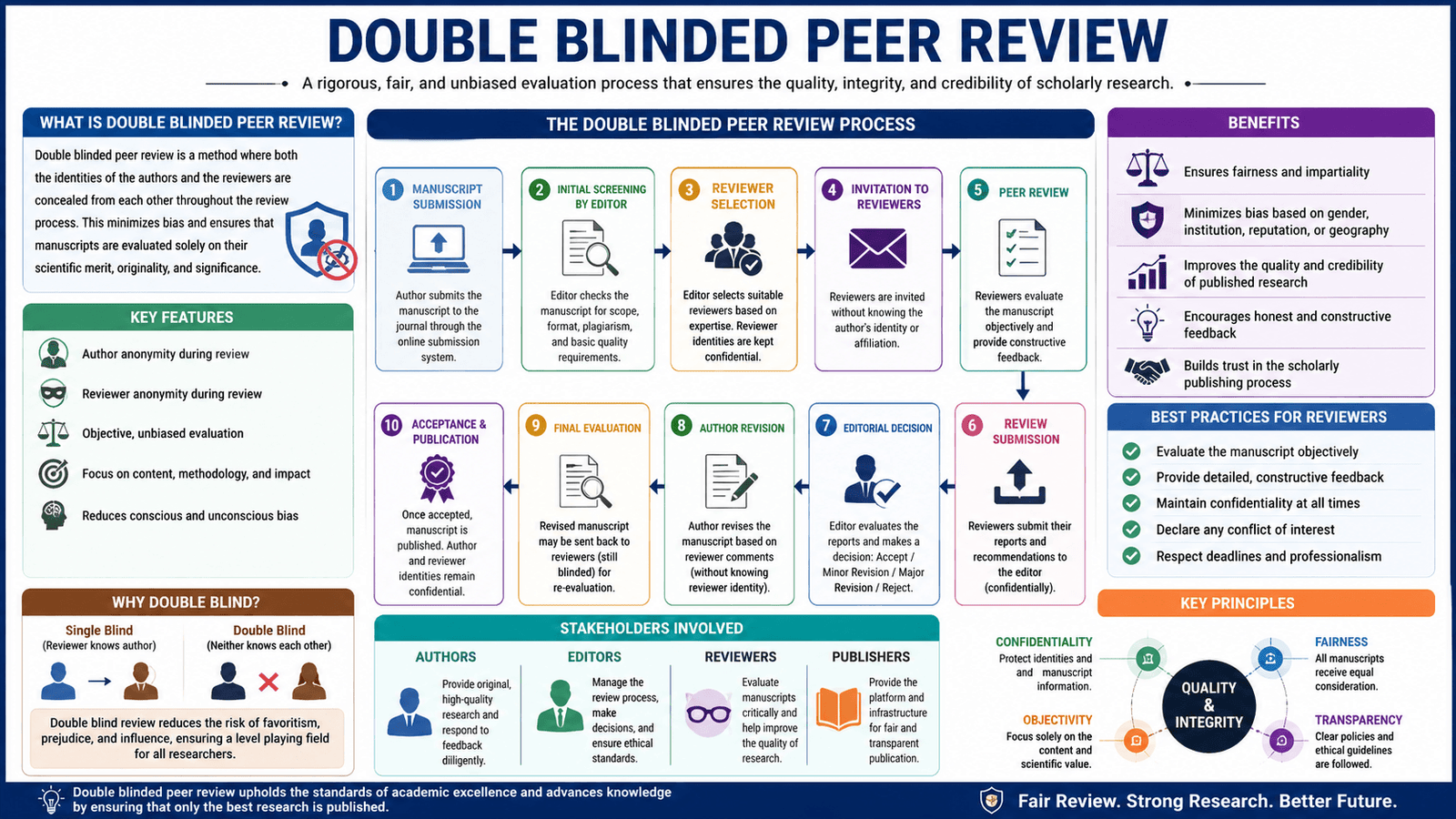
The International Journal of Computer Science , Engineering and Artificial Intelligence, e-ISSN: 3139 - 9002 strtly follow double-blind peer review process is a commonly used method in academic publishing where both the identities of the authors and the reviewers are kept confidential. This process aims to ensure impartiality and reduce biases, ensuring that the review is based solely on the quality of the work rather than the identity or reputation of the individuals involved.
Double Binded Peer Review Process
The double-blind peer review process is a standard method used to ensure impartial and unbiased evaluation of scholarly manuscripts. In this system, both the authors and the reviewers remain anonymous to each other throughout the review process. This anonymity minimizes potential biases related to the authors’ identity, affiliation, reputation, gender, or nationality, allowing the manuscript to be judged solely on its scientific merit, originality, methodology, and clarity.
Upon submission to the journal, the manuscript is first screened by the editorial team for compliance with formatting, scope, and ethical guidelines. If deemed suitable, it is forwarded to independent expert reviewers who evaluate the study based on predefined criteria such as research quality, novelty, data integrity, and relevance to the field. Reviewers provide constructive feedback, suggestions for improvement, and recommendations regarding acceptance, revision, or rejection.
The IJCSER Journal editorial board considers the reviewers’ reports while making the final decision, ensuring transparency, fairness, and accountability. Authors are required to address reviewer comments during revisions, maintaining the integrity of the publication process. By maintaining the double-blind system, IJCSER journal uphold rigorous academic standards, reduce potential conflicts of interest, and promote high-quality, objective, and credible scientific publications.
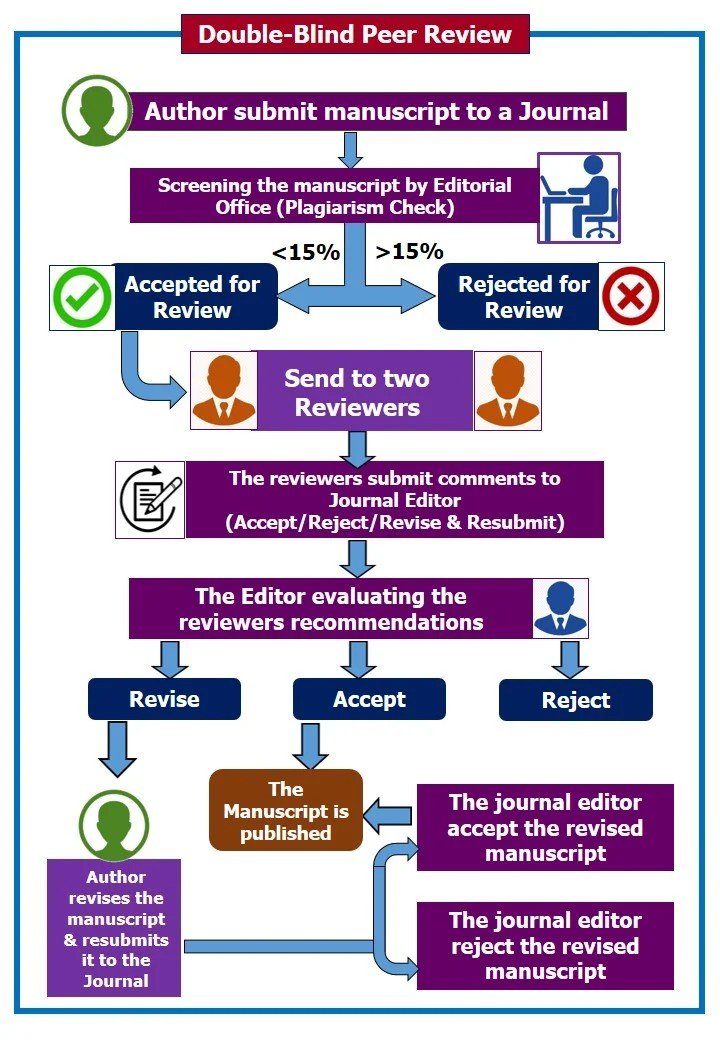
Here’s a detailed breakdown of how the double-blind peer review process typically works:
Submission of Manuscript
The process begins when an author submits a manuscript to an academic journal. The submission usually includes the manuscript itself, along with any additional documents required by the journal (e.g., cover letter, conflict of interest statement, suggested reviewers).
Initial Screening
The journal’s editorial team or managing editor performs an initial screening of the manuscript. This involves checking for completeness, formatting adherence, relevance to the journal’s scope, and compliance with ethical standards. If the manuscript passes this initial stage, it proceeds to the peer review process. In some cases, editors might reject manuscripts that are deemed irrelevant or below the journal's standards without sending them for peer review.
Selection of Reviewers
The editor selects a group of experts in the subject matter of the manuscript to review the work. These are typically researchers with experience in the field relevant to the submitted paper. Reviewers are usually chosen based on their expertise, previous publications, and willingness to engage in the review process. In double-blind peer review, the identities of the authors are hidden from the reviewers, and the identities of the reviewers are also kept confidential from the authors.
Anonymous Review Process
Once the reviewers are chosen, they are invited to evaluate the manuscript. The manuscript is provided to the reviewers without the authors' names, affiliations, or any identifying information. Reviewers are asked to evaluate the manuscript based on various criteria, such as:
- Originality and novelty of the research
- Quality of the research methodology and data analysis
- Clarity and structure of the writing
- Contribution to the field
- Ethical considerations
Reviewers are often encouraged to be constructive, providing feedback and suggestions for improvement, as well as making a recommendation about whether the manuscript should be accepted, revised, or rejected.
Reviewer Recommendations
After reviewing the manuscript, each reviewer submits their evaluation, which typically includes:
- A summary of the manuscript's strengths and weaknesses
- A recommendation (accept, minor revisions, major revisions, or reject)
- Suggestions for improving the paper
The editor evaluates all the feedback from the reviewers and makes a decision. The recommendations of the reviewers are taken into account, but the final decision rests with the editor.
Author Revision
If the reviewers suggest revisions, the author is asked to revise the manuscript based on the feedback provided. The revised manuscript is then resubmitted for further review, sometimes by the same reviewers. In some cases, if major revisions are required, the manuscript may go through multiple rounds of peer review to ensure the paper meets the journal's standards.
Final Decision
Once the manuscript meets the required standards and all reviewer concerns have been addressed, the editor makes the final decision. The manuscript is either:
Accepted for Publication : Accepted with minor or major revisions required (with the manuscript returning to the reviewers for further evaluation if necessary)
Rejected due to insufficient quality or relevance
Post-Publication
If accepted, the manuscript goes through the publication process, including typesetting, proofreading, and final approval. In some journals, after publication, the peer review reports may be made publicly available, sometimes along with the final version of the article.
Benefits of Double-Blind Peer Review:
Reduces Bias: By keeping the identities of both authors and reviewers anonymous, the process reduces potential biases based on the authors’ reputation, gender, institutional affiliation, or other factors that might influence the review process.
Focus on Content: The reviewers’ evaluations are based solely on the scientific or academic quality of the work, rather than any preconceived notions about the authors.
Fairer Assessment: New or lesser-known researchers have a fairer chance of having their work assessed based on its merits, not the reputation of the authors.
Editorial Peer Review and Citation Manipulation Policy
The International Journal of Computer Science, Engineering, and Artificial Intelligence (IJCSEAI) is committed to maintaining a rigorous, fair, transparent, and academically independent editorial and peer-review process.
Author Self-Citation: Authors are permitted to cite their previous work when it is genuinely relevant to the manuscript.Self-citation shall be evaluated according to scholarly relevance and context rather than by applying an arbitrary numerical threshold.Excessively cite their own publications,Add irrelevant self-citations. Omit relevant work solely to manipulate citation patterns. Create reciprocal citation arrangements; or Artificially inflate the citation count of an author, group, institution, or journal.
Journal Self-Citation: IJCSEAI does not require authors to cite articles previously published in IJCSEAI merely to increase journal citation metrics. Authors may cite IJCSEAI articles when those articles are genuinely relevant to the submitted research.Editors and reviewers may recommend IJCSEAI articles only when there is a clear academic justification. The journal will not use acceptance decisions as a mechanism for increasing journal self-citation. This principle is particularly important because inappropriate requests for citations to a journal's own publications may constitute citation manipulation when the purpose is to influence journal metrics rather than improve the scholarly quality of the article.
Reviewer Self-Citation: Reviewers must not request citations to their own publications merely to increase their citation counts, h-index, visibility, or academic profile.A reviewer may recommend their own work only when it is directly relevant to the manuscript and the recommendation is supported by a legitimate scholarly reason.Reviewers should avoid repeatedly recommending their own publications when equivalent or more appropriate literature exists. Where a reviewer recommends several of their own publications, the editor may independently assess the recommendations and remove inappropriate citation requests before forwarding the review to the authors.
Reviewer Independence and Conflicts of Interest: Reviewers must disclose any actual, potential, or perceived conflict of interest before accepting a review assignment. A reviewer should normally decline a review when: they have a significant personal or professional relationship with an author; they are affiliated with the same institution as an author; they have a recent collaboration or competing research interest that could affect objectivity; they have a financial or commercial interest in the outcome; they are unable to provide an impartial assessment; or they believe their participation could create an appearance of bias. Editors may replace reviewers where a conflict of interest or other concern is identified.
Prohibition of Coerced Citations: IJCSEAI strictly prohibits coerced citation. A citation request is considered potentially coercive when an editor or reviewer implies, explicitly or indirectly, that acceptance, favorable review, publication speed, or editorial treatment depends upon adding citations that are not scientifically justified. These actions are strictly prohibited, those are Add citations to our journal before the paper can be accepted. Requiring authors to cite the editor's publications without a legitimate scholarly reason. Requiring authors to cite a reviewer's publications merely to increase the reviewer's citation count. Requiring an arbitrary number of citations to IJCSEAI articles. Requiring citations to a particular research group without scientific justification; or threatening rejection solely because an author refuses an irrelevant citation request. Authors are entitled to question citation recommendations that they reasonably believe are irrelevant or inappropriate.
Citation Cartels and Reciprocal Citation Arrangements: IJCSEAI prohibits organized or reciprocal citation arrangements intended to manipulate citation metrics. Potentially unethical practices include: Agreements between authors to cite each other's publications regardless of relevance. Coordinated citation between journals. Systematic citation exchanges between research groups. Excessive citation of a particular journal without scholarly justification. Coordinated efforts to increase author or journal citation metrics, and Submission practices designed primarily to generate artificial citation networks. Evidence of systematic or coordinated citation manipulation may result in editorial investigation.
Citation Cartels and Reciprocal Citation Arrangements: IJCSEAI prohibits organized or reciprocal citation arrangements intended to manipulate citation metrics. Potentially unethical practices include: Agreements between authors to cite each other's publications regardless of relevance. Coordinated citation between journals. Systematic citation exchanges between research groups. Excessive citation of a particular journal without scholarly justification. Coordinated efforts to increase author or journal citation metrics, and Submission practices designed primarily to generate artificial citation networks. Evidence of systematic or coordinated citation manipulation may result in editorial investigation.
Excessive and Irrelevant Citations: Authors are expected to cite literature that is relevant, accurate, and necessary to support their work. The following practices are discouraged or prohibited where undertaken for manipulation, those are adding large numbers of irrelevant references, citing papers that do not support the associated claim, excessive references to a particular journal, excessive references to a particular author or research group; unnecessary citation of the author's own publications, adding references solely to improve perceived scholarly impact and deliberately constructing an artificial citation network. Reference lists should reflect the genuine intellectual foundation of the research.
Editorial Monitoring: IJCSEAI will periodically monitor citation practices as part of its publication-quality and research-integrity procedures. The editorial office may examine, those are Unusual concentrations of citations to a particular journal; Unusually high levels of self-citation; Repeated citation patterns among authors; Reviewer citation recommendations; Excessive citation recommendations involving editors or editorial board members; Suspicious reciprocal citation patterns; and Other unusual citation behavior that may indicate manipulation. Citation monitoring is intended to protect scholarly integrity and will not be used to impose arbitrary citation targets. The journal recognizes that legitimate citation patterns vary substantially by discipline, article type, research topic, and publication history.
Handling Suspected Citation Manipulation: When citation manipulation is suspected, the Editor-in-Chief or designated editorial ethics editor may initiate an investigation. The investigation may include: reviewing the manuscript and reference list; examining reviewer reports and citation recommendations, assessing the relevance of disputed references, communicating with the author, reviewer, or editor concerned, requesting clarification or supporting information, examining whether the behavior appears isolated or systematic, and consulting appropriate publication-ethics guidance where necessary. The investigation shall be conducted fairly and confidentially. A suspicion alone shall not automatically be treated as proof of misconduct.
Possible Editorial Actions: Depending on the seriousness and evidence available, IJCSEAI may take one or more of the following actions are implemented Before Publication, those are request removal of irrelevant citations, ask authors to revise the reference list; disregard inappropriate reviewer citation recommendations, replace a reviewer, assign an independent editor, issue an editorial warning, reject a manuscript where systematic manipulation is established, or refer serious cases to the relevant institution or authority where appropriate.
After Publication , immediate action will be taken Where credible evidence of citation manipulation is identified after publication, the journal may publish a correction; publish an editorial note or expression of concern, investigate the associated articles or publication process, request institutional investigation where appropriate, retract an article where the integrity of the publication is materially compromised, or take other appropriate action consistent with publication-ethics principles. Evidence of citation manipulation can constitute grounds for article withdrawal or retraction under established publishing-ethics practices.
Appeals and Complaints: Authors, reviewers, editors, and other stakeholders may raise concerns regarding suspected citation manipulation or inappropriate editorial conduct. Complaints should provide sufficient information to allow the journal to assess the concern, including, where possible: manuscript or article identification, relevant correspondence, details of the disputed citation request, explanation of why the citation appears inappropriate, and any supporting evidence. Complaints will be reviewed objectively and confidentially. Where appropriate, the journal may appoint an independent editor who was not involved in the original decision. The journal will not retaliate against individuals who raise concerns in good faith.
Commitment to Continuous Improvement: IJCSEAI recognizes that publication ethics and scholarly communication practices continue to evolve. The journal will periodically review this policy and update its editorial procedures where necessary to reflect developments in publication ethics, peer-review standards, research integrity, citation practices, indexing requirements, and recommendations issued by recognized scholarly and publication-ethics organizations. IJCSEAI is committed to maintaining a publication environment in which editorial decisions are based on scholarly merit and citations reflect genuine academic relationships between publications.
 News Board
 Cover Page



 Manuscript Status