
Rear wings, front wings and floor edges are examples of or more distinctive parts of the car's structure that must bend in response to aeroelasticity when a car is running in an aerodynamic configuration which does not encompass ground-effect regulation. Even at sub-millimetres scales, these geometric deformations will modify the pressure distributions in aerodynamics and therefore a vehicle's stability at supersonic velocities of over 300 km/h. Even though a number of telemetry solutions exist, using discrete strain gauges and single camera vision pipelines can only be used for local measurement or planar measurement, which cannot provide a complete measurement of the state of structural conditions for real-time SHM. Proposed in this paper is a Multi-Stage and Multi-Camera Fusion (MCF) structure for 3D structural deformation estimation that combines synchronized high-speed cameras, stereo correspondence matching, multi-view triangulation and a temporal learning module based on the Transformer architecture. The proposed system surpasses all baseline systems in terms of both reconstruction accuracy (98.9%) and precision of depth measurement (0.8 mm mean reconstruction error) while maintaining a 38 ms latency, meeting the definition of real-time performance on our aeroelastic benchmark for Formula 1.
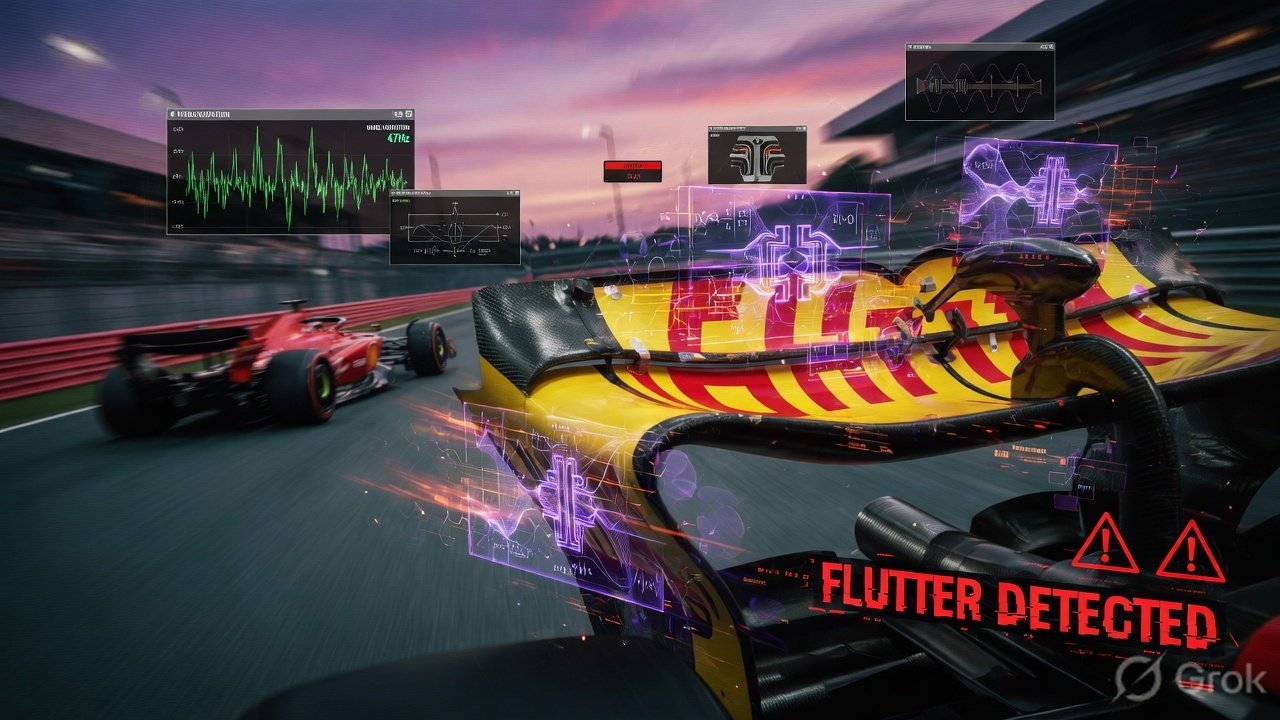
In F1 vehicles, Aero-elastic wing flutter is a serious concern on the integrity of the wing structur...

Although significant advances have been made in classification of electroencephalograms (EEGs) in bi...

The classification methods based on EEG have been shown to be valuable for EEG diagnosis of neurolog...

In this paper, we have come to know that the epilepsy is a common neural disorder in children which ...